Managed Print Services vs. Traditional Printer Service Contracts: What’s the Difference?
When a business relies on printers, copiers, and multifunction devices every day, keeping that equipment running is essential. But there’s a major difference between simply having someone available to repair a printer and having a strategy for managing your entire print environment.
That’s where the difference between a traditional printer service contract and Managed Print Services (MPS) becomes important.
A traditional printer service contract is generally focused on maintaining or repairing specific equipment. Managed Print Services takes a broader approach, looking at how your business prints, what devices you use, what those devices cost to operate, how supplies are managed, where inefficiencies exist, and how your print environment can be improved over time.
For businesses trying to reduce printing costs, improve productivity, strengthen printer security, and simplify the management of multiple office printers and copiers, understanding the difference can help determine which approach makes the most sense.
What Is a Traditional Printer Service Contract?
A traditional printer or copier service contract is primarily designed to keep covered equipment operational.
Depending on the agreement, a service contract may include preventative maintenance, repairs, replacement parts, technician labor, toner or other supplies, and support when equipment experiences problems.
For many businesses, this can be perfectly adequate. If you have only one or two devices, relatively predictable printing needs, and someone internally who already manages supplies and equipment decisions, a traditional service agreement may provide the support you need.
The limitation is that the contract is generally centered around servicing the equipment you already have.
It may not answer larger questions such as:
- Are we paying too much to print?
- Do we have more printers than we actually need?
- Are employees using the most cost-effective device for each print job?
- How much are we spending across our entire printer fleet?
- Which machines are overused or underused?
- Are we ordering too much toner?
- Are aging devices increasing maintenance costs?
- Are our printers configured with appropriate security features?
- Should certain devices be replaced, consolidated, or relocated?
That’s where managed print services begins to look very different.
What Are Managed Print Services?
Managed Print Services (MPS) is a more comprehensive approach to managing an organization’s printers, copiers, multifunction devices, supplies, service needs, usage, and overall printing costs.
Instead of looking at each printer independently, a managed print provider evaluates the print environment as a whole.
That process typically begins with a managed print assessment.
During an assessment, a provider can evaluate your current printer fleet, device locations, print volumes, equipment age, supply usage, service history, workflows, and other factors affecting the cost and efficiency of business printing.
From there, the goal isn’t simply to fix what’s broken.
It’s to determine: Is there a better way to manage the entire print environment?
That could mean consolidating unnecessary devices, replacing inefficient equipment, automating toner replenishment, monitoring printer usage, improving device placement, establishing predictable service, or identifying opportunities to reduce unnecessary printing.
Managed Print Services vs. Printer Service Contracts
Although the two services can overlap, their scope is considerably different.
| Traditional Printer Service Contract | Managed Print Services | |
|---|---|---|
| Printer repairs | ✓ | ✓ |
| Preventative maintenance | ✓ | ✓ |
| Toner/supply programs | Sometimes | ✓ |
| Fleet monitoring | Limited/varies | ✓ |
| Print usage analysis | Limited | ✓ |
| Cost optimization | Limited | ✓ |
| Device utilization analysis | — | ✓ |
| Fleet optimization | — | ✓ |
| Strategic equipment planning | Limited | ✓ |
| Ongoing print management | — | ✓ |
| Security considerations | Varies | ✓ |
| Proactive recommendations | Limited | ✓ |
The easiest way to think about the difference is:
A service contract helps maintain your printers.
Managed Print Services helps manage your printing environment.
And for organizations with numerous devices, departments, locations, users, or vendors, that distinction can become increasingly important.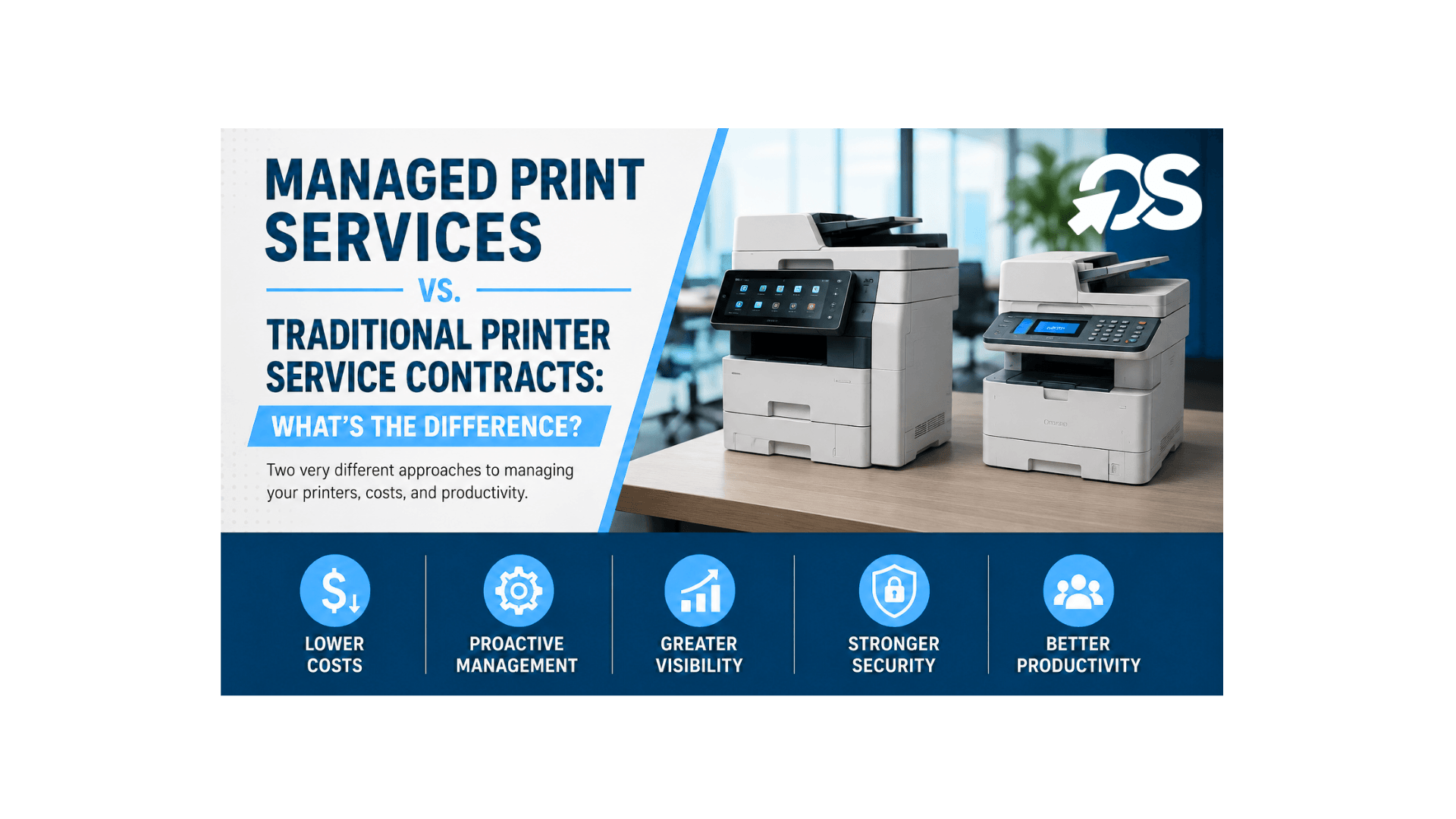
1. MPS Looks Beyond the Cost of the Printer
One of the biggest mistakes businesses make when evaluating printers is looking primarily at the equipment payment or purchase price.
The true cost of business printing can extend far beyond the machine itself.
Businesses may also be paying for:
- Toner and supplies
- Replacement parts
- Service calls
- IT support
- Paper
- Energy consumption
- Multiple vendor contracts
- Employee time spent troubleshooting
- Underused equipment
- Excessive color printing
- Unnecessary print jobs
- Downtime caused by unreliable equipment
This is why managed print costs should be evaluated across the entire print environment, rather than device by device.
For businesses wondering what an MPS program actually costs, we’ve broken down the factors that influence pricing in our How Much Do Managed Print Services Cost? guide.
2. Managed Print Services Can Identify an Inefficient Printer Fleet
Imagine an office with 30 printers.
On paper, everything seems fine.
But a closer look reveals:
- Five printers receive extremely high usage.
- Eight are barely used.
- Several departments have personal desktop printers.
- Employees routinely print color documents unnecessarily.
- Multiple printer models require different toner inventories.
- Some equipment is significantly older than the rest.
- IT regularly gets pulled away from other responsibilities to troubleshoot printers.
A traditional service agreement might successfully maintain those 30 devices.
Managed Print Services asks whether the business should have those 30 devices configured that way in the first place.
That difference can uncover opportunities to consolidate equipment, standardize devices, improve placement, balance print volume and simplify supply management.
3. MPS Shifts Printer Management From Reactive to Proactive
There’s a familiar cycle in many offices:
Printer breaks → employee notices → IT gets involved → service provider is contacted → technician responds → printer gets repaired.
That’s reactive printer management.
A managed print strategy attempts to reduce how often the business operates that way.
Depending on the technology and MPS program, device monitoring can help identify supply levels, usage patterns, service conditions and other information that allows problems to be addressed more proactively.
That can also make toner management easier.
Instead of employees discovering they’re out of toner when a cartridge runs dry or keeping closets filled with cartridges “just in case” supply replenishment can become part of the managed process.
The result is a print environment that requires less day-to-day attention from employees and internal IT teams.
4. Printer Security Becomes Part of the Conversation
Modern multifunction printers aren’t simply machines that put toner on paper.
They can connect to networks, process documents, scan files, send information, authenticate users and, in many cases, contain internal storage.
That makes printer security something businesses shouldn’t overlook.
The Federal Trade Commission specifically advises businesses to include digital copiers in their information-security plans. The FTC notes that copier hard drives can store information from documents that are copied, printed, scanned, faxed or emailed and recommends considering features such as encryption and overwriting when purchasing or leasing equipment.
A managed print assessment creates an opportunity to consider equipment age, device configuration and available security capabilities as part of the overall print strategy rather than treating printers as isolated office equipment.
5. MPS Can Help Standardize a Messy Print Environment
Printer fleets tend to grow gradually.
A department buys one printer.
Another department leases a copier.
Someone orders a desktop printer.
Another location uses completely different equipment.
Five years later, the company may have a mixture of manufacturers, models, toner cartridges, service agreements and vendors.
That’s when print management becomes unnecessarily complicated.
A managed print provider can evaluate the fleet and look for opportunities to create a more standardized environment.
Standardization can make it easier to manage:
- Supplies
- Service
- Equipment replacement
- User training
- Device configuration
- Print policies
- Vendor relationships
- Future equipment planning
Instead of managing printers as dozens of individual purchases, the organization begins managing them as one business system.
6. Managed Print Services Can Support Sustainability Goals
An efficient print environment isn’t only about reducing costs.
It can also help businesses reduce unnecessary printing, improve device utilization and make smarter equipment decisions.
ENERGY STAR recommends several strategies for office imaging equipment, including using automatic duplex printing, maintaining energy-saving sleep settings and selecting equipment appropriately sized for actual printing needs. ENERGY STAR also notes that certified printers and copiers can use significantly less energy than conventional equipment.
A managed print strategy can complement these efforts by helping organizations understand where, why and how much they’re printing before making decisions about equipment and workflows.
7. MPS Provides Data for Future Equipment Decisions
Another major difference between traditional printer service and managed print services is what happens when equipment reaches the end of its useful life.
Without good information, replacement decisions can become:
“This printer is old. Let’s buy another one.”
But age alone doesn’t tell the whole story.
Print volume, service history, downtime, operating cost, departmental requirements and utilization should all factor into the decision.
With better visibility into the print environment, businesses can make more strategic decisions about whether to:
Replace → Relocate → Consolidate → Upgrade → Retire
That can be especially useful when a copier lease is approaching expiration.
Instead of automatically renewing, upgrading or purchasing equipment, businesses can evaluate what their print environment actually needs going forward.
When Does a Traditional Printer Service Contract Make Sense?
Managed Print Services isn’t automatically the right solution for every organization.
A traditional printer service contract may make sense if your business:
- Has very few printers or copiers
- Has straightforward printing requirements
- Already manages toner and supplies efficiently
- Has predictable printing volumes
- Doesn’t require fleet-level reporting or optimization
- Primarily wants reliable repair and maintenance coverage
For a small office with one copier, there may simply not be much of a “fleet” to optimize.
And that’s okay.
The goal should be finding the right level of support not making print management more complicated than it needs to be.
When Should You Consider Managed Print Services?
MPS becomes especially valuable as the print environment becomes more complex.
Your organization may benefit from business print management if:
- You operate numerous printers and copiers.
- You have multiple offices or departments.
- Printing costs are difficult to track.
- Employees frequently run out of toner.
- Your IT department spends too much time troubleshooting printers.
- Equipment was purchased at different times without an overall strategy.
- You use multiple printer vendors.
- Your fleet contains aging or inefficient equipment.
- You experience recurring service issues.
- You want greater visibility into printing activity.
- You’re unsure what your printers actually cost to operate.
If several of those sound familiar, the problem may not be a single printer.
It may be the way the entire print environment is being managed.
Is Managed Print Services More Expensive Than a Service Contract?
Not necessarily. and comparing the monthly price of the two can be misleading because they may cover very different things.
A basic printer service contract may appear less expensive because its scope is narrower.
Managed Print Services may combine or address expenses that were previously spread across several areas of the business, such as equipment service, toner, supplies, device monitoring and print management.
The better question isn’t simply:
“Which contract costs less?”
It’s:
“What is our total cost of printing, and which approach gives us the best combination of cost control, reliability, support and efficiency?”
That’s why establishing your current printing costs is an important part of evaluating MPS.
How Do You Choose Between Managed Print Services and a Printer Service Contract?
Start by understanding what you’re actually trying to solve.
If your primary concern is:
“Who will repair our copier when it breaks?”
A traditional service contract may be enough.
But if your questions sound more like:
“Why are we spending so much on printing?”
“Why do we have so many printers?”
“Why is IT constantly dealing with toner and printer problems?”
“Which devices should we replace?”
“How do we manage printers across multiple departments or locations?”
Then you’re no longer dealing with just a printer-service issue.
You’re dealing with a print management issue.
And that’s where Managed Print Services can provide significantly more value.
Start With a Managed Print Assessment
You don’t have to replace every printer or completely overhaul your environment to determine whether Managed Print Services makes sense.
Start with the data.
A managed print assessment can provide a clearer picture of your current equipment, usage, expenses and opportunities for improvement.
At Office Source, we work with businesses to evaluate their existing print environments and identify practical ways to simplify printer management, control costs and build a print strategy around how the organization actually operates.
Whether the right answer is optimizing your existing fleet, replacing aging equipment, consolidating devices or simply improving how your printers are managed, the first step is understanding what you have today.
FAQ: Managed Print Services vs. Printer Service Contracts
What is the main difference between Managed Print Services and a printer service contract?
A traditional printer service contract primarily focuses on maintaining and repairing covered equipment. Managed Print Services takes a broader approach by evaluating and managing the overall print environment, which may include service, supplies, device monitoring, usage analysis, fleet optimization and long-term equipment planning.
Does Managed Print Services include printer repairs?
Managed Print Services programs commonly include service and maintenance, although the exact coverage depends on the provider and agreement. Businesses should review precisely what equipment, parts, labor, supplies and services are included before signing a contract.
Can Managed Print Services help reduce printing costs?
MPS can identify potential sources of unnecessary spending such as underused devices, inefficient equipment, excessive printing, fragmented supply purchasing and poor device placement. Actual savings will depend on the organization’s existing print environment.
Is Managed Print Services only for large companies?
No. The better indicator is usually print complexity, not simply employee count. A smaller organization with multiple devices, locations or significant print volume may benefit from managed print, while a company with very limited printing needs may be adequately served by a traditional service agreement.
What happens during a managed print assessment?
A managed print assessment typically evaluates the organization’s current printers and copiers, usage, print volumes, equipment age, device placement, operating costs and other factors that influence the efficiency of the print environment.
Ready to Find Out What Your Print Environment Is Really Costing You?
Schedule a managed print assessment with Office Source and let’s take a closer look.