Closing a Business? What Documents Need Secure Destruction
Closing a business is never as simple as locking the doors for the last time. Along with final tax filings, employee notifications, and equipment liquidation, business owners are left with years of confidential paperwork that can’t simply be thrown into a dumpster.
Record retention requirements vary based on the type of document, applicable federal and state laws, and your industry. Before destroying business records, confirm the appropriate retention period with your accountant, attorney, or records-management professional. The guidelines below provide general examples of common retention requirements.
Customer records, payroll files, tax documents, contracts, financial statements, and employee information often contain sensitive data that could expose your business, former employees, or customers to identity theft, fraud, or compliance issues if disposed of improperly.
Before you clear out filing cabinets or archive boxes, it’s important to understand which documents should be securely destroyed, which should be retained, and why professional document shredding is one of the safest ways to protect your business during the closure process.
In this guide, shredding services experts in St. Louis will walk you through exactly what to keep, how long to keep it, and what needs to be securely destroyed before you truly move on.
Why Secure Document Destruction Matters When Closing a Business
Many business owners assume that once operations stop, the risk of data theft disappears.
In reality, closing a business often creates one of the greatest opportunities for confidential information to be exposed.
During the closing process, businesses typically sort through years of paper records containing:
- Customer information
- Employee records
- Financial statements
- Tax documents
- Banking information
- Vendor contracts
- Legal files
- Healthcare or insurance records
Throwing these documents in the trash or even into a recycling bin can leave sensitive information vulnerable to unauthorized access.
Professional shredding ensures confidential records are permanently destroyed while providing documentation that the destruction was completed securely.
Related Reading: Learn how to Securely Dispose of Confidential Materials with Onsite Shredding
What Records You Must Retain And For How Long
Before anything gets destroyed, it is important to understand that closing your business does not wipe the slate clean on your record-keeping responsibilities. Many documents must be retained for specific periods even after operations cease, and when that period expires, they cannot simply go into the trash or recycling bin. It is a legal necessity that any document containing sensitive information requires secure, verified destruction.
Here is a quick-reference guide to what you are legally required to keep and for how long, based on IRS guidelines:
| Record Type | Retention Period |
| Tax returns and supporting documents | 7 years (safe standard) |
| Employment tax records (W-4s, payroll taxes) | 4 years after tax paid |
| Personnel / HR files | 1 year after termination (EEOC minimum) |
| Payroll records | 3 years (FLSA requirement) |
| Employee benefit plans | Duration of plan + 1 year |
| Contracts | 7 years after expiration |
| Corporate formation documents | Permanently |
Why Secure Destruction Is Legally Required
Regulatory obligations do not cease with business closure. Simply placing documents in a recycling bin post business closure is a federal violation if they contain names, Social Security numbers, or financial data. Federal law still applies to how you dispose of sensitive records.
The FACTA Disposal Rule, enforced by the Federal Trade Commission, applies to any business that handles consumer financial information or uses consumer reports.
Under this rule, businesses must take reasonable measures to prevent unauthorized access to sensitive data when disposing of records. The FTC specifies that acceptable methods include shredding, burning, or pulverizing paper documents, and completely destroying electronic media so it cannot be reconstructed.
The penalties for getting this wrong are significant. Businesses can face fines of up to $2,500 per violation at the federal level, plus up to $1,000 per violation at the state level, and class-action lawsuits from individuals whose data was exposed.
Proper document shredding is the standard the law expects. Whether you are winding down a small family business or a multi-location operation, that standard applies equally.
Which Business Documents Should Be Securely Shredded?
Not every document should be destroyed immediately. Some records must be retained to meet legal, tax, or regulatory requirements. Once you’ve confirmed records are no longer required, however, secure shredding is the safest way to dispose of them.
Below are some of the most common document categories businesses should securely destroy when appropriate.
Customer Records
Customer files often contain personally identifiable information (PII), including names, addresses, phone numbers, financial information, and account details.
Examples include:
- Customer applications
- Service agreements
- Credit applications
- Purchase histories
- Payment information
- Client correspondence
If these documents are no longer required for legal or operational purposes, they should be securely shredded rather than discarded.
Employee Records
Human Resources records are among the most sensitive documents any business maintains.
Examples include:
- Employment applications
- Performance reviews
- Payroll records (after required retention)
- Background checks
- Benefit enrollment forms
- Disciplinary documentation
- Emergency contact information
- Direct deposit forms
Because these records often contain Social Security numbers, banking information, and other confidential data, secure destruction is essential once retention requirements have been met.
Financial Documents
Businesses generate thousands of financial records over the years.
These may include:
- Bank statements
- Vendor invoices
- Expense reports
- Purchase orders
- Credit card statements
- Accounts payable records
- Accounts receivable files
Once you’ve confirmed these records are no longer needed for tax or accounting purposes, secure shredding helps prevent financial information from falling into the wrong hands.
Tax Documents
Tax records often require longer retention periods than other business documents.
Before destroying any tax-related records, consult your accountant or tax advisor to confirm you’ve met all applicable retention requirements. The IRS provides guidance on how long different records should generally be kept before disposal.
Once eligible for disposal, documents such as supporting tax records, duplicate returns, and related financial paperwork should be securely shredded. Not sure which tax records are ready for destruction? Read our guide to what financial records you can shred after tax season.
Legal and Corporate Records
Businesses also maintain legal documentation throughout their lifecycle.
Examples include:
- Expired contracts
- Vendor agreements
- Old insurance policies
- Litigation files
- Meeting minutes (where appropriate)
- Confidential legal correspondence
Some legal records should be retained permanently, while others may eventually be destroyed based on legal advice and retention policies.
Outdated Business Records
Many offices accumulate years of paperwork that no longer serves a business purpose.
This may include:
- Duplicate copies
- Draft proposals
- Obsolete policies
- Expired marketing materials
- Old internal reports
- Archived administrative paperwork
Removing unnecessary records before closing your business can simplify the transition while reducing storage costs.
Electronic Media
- Hard drives, laptops, and office copiers
- USB drives and backup storage devices
Do not overlook digital records. Hard drives and storage devices hold just as much sensitive information as any paper file, sometimes more. Business closing document destruction must include both physical and electronic media to be truly complete and compliant.
Documents You May Need to Keep
While secure shredding is an important part of closing a business, not every document should be destroyed immediately.
Depending on your business structure and industry, you may need to retain certain records, including:
- Final tax returns
- Articles of incorporation
- Business licenses
- Property records
- Employee tax records
- Retirement plan documents
- Corporate dissolution paperwork
The IRS recommends keeping different categories of business records for varying lengths of time, so it’s important to review your obligations before scheduling document destruction.
The Cost of Getting It Wrong
If the legal requirements alone are not enough to take this seriously, consider what has already happened to businesses that underestimated the importance of secure document disposal.
In 2008, American United Mortgage Company was fined $50,000 by the FTC after improperly discarding sensitive consumer financial records. These documents, which contained private customer data, were left accessible to the public. What may have seemed like a minor lapse turned into a costly compliance failure.
An even more severe example is the Morgan Stanley case. The firm faced a $35 million penalty after hiring an unqualified vendor to decommission hard drives containing personal data of nearly 15 million customers. The drives were never properly destroyed, leading to a massive data exposure incident. The financial loss was significant, but the reputational damage was even greater.
These are not rare or isolated incidents. Data exposure has very real consequences, especially for smaller businesses. Shredding when closing business operations is not just another task to complete. It is a necessary step to protect yourself from legal and financial consequences years after the business is gone.
How Professional Shredding Protects You
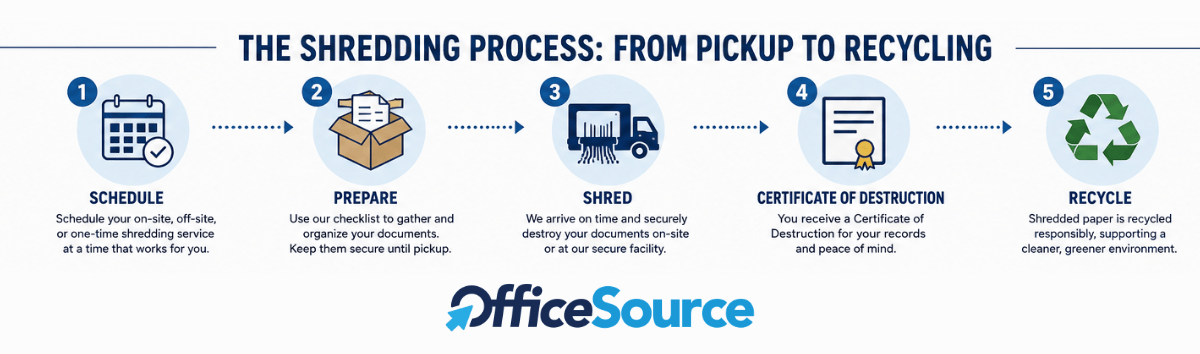
Closing a business is already one of the most stressful transitions you will go through. The last thing you need is to spend hours sorting through years of paperwork, wondering what to keep, what to destroy, and whether you are doing it correctly.
That is exactly where professional shredding services take the pressure off. When you work with a certified provider, you get:
- Certificate of Destruction: Documented proof that your sensitive information was handled responsibly, which becomes your compliance record if questions ever arise
- Chain of custody: Your documents are tracked and accounted for from the moment they leave your hands to the moment they are destroyed
- On-site or off-site options: On-site shredding happens at your location or securely off-site, whatever works best for your timeline
- Electronic media handling: Hard drives, laptops, USB drives, and office copiers all get properly destroyed, not just paper
When you are already managing a hundred moving parts, having one trusted partner handle secure destruction cleanly and completely is just smart business, right up until the very end.
Why Professional Shredding Is Better Than Office Shredders
Many businesses own small office shredders, but closing a business often involves hundreds or even thousands of pounds of confidential documents.
Professional shredding offers several advantages:
- Faster processing of large volumes
- Secure chain of custody
- On-site destruction options
- Certificate of Destruction
- Reduced employee labor
- Compliance support
- Environmentally responsible recycling
Instead of spending days feeding paper into a small shredder, businesses can securely destroy years of records in a single service appointment.
One-Time Shredding Is Ideal for Business Closures
Unlike businesses that require recurring shredding services, organizations preparing to close often benefit from a one-time document purge. For businesses closing an office in St. Louis, a one-time document purge can be especially useful when a large volume of archived records needs to be cleared before a lease ends, property is sold, or the space is turned over.
A one-time shredding service allows you to:
- Clear storage rooms
- Empty filing cabinets
- Destroy confidential paperwork
- Prepare offices for sale or lease turnover
- Protect customer and employee information
This is one of the most efficient ways to complete the final stages of a business closure.
Business Closure Document Destruction Checklist
Before your final move-out, ask yourself:
- ✔ Have confidential customer files been reviewed?
- ✔ Have employee records been retained or securely destroyed according to legal requirements?
- ✔ Have outdated financial documents been removed?
- ✔ Have confidential contracts been reviewed?
- ✔ Have archived storage boxes been evaluated?
- ✔ Have hard drives and electronic storage devices been addressed separately?
- ✔ Have paper records been securely shredded instead of discarded?
A little preparation now can help protect your former customers, employees, and business long after your doors have closed. Not sure which documents to shred? Check out our Shredding Day Checklist.
Close Your Business the Right Way with Secure Shredding Services
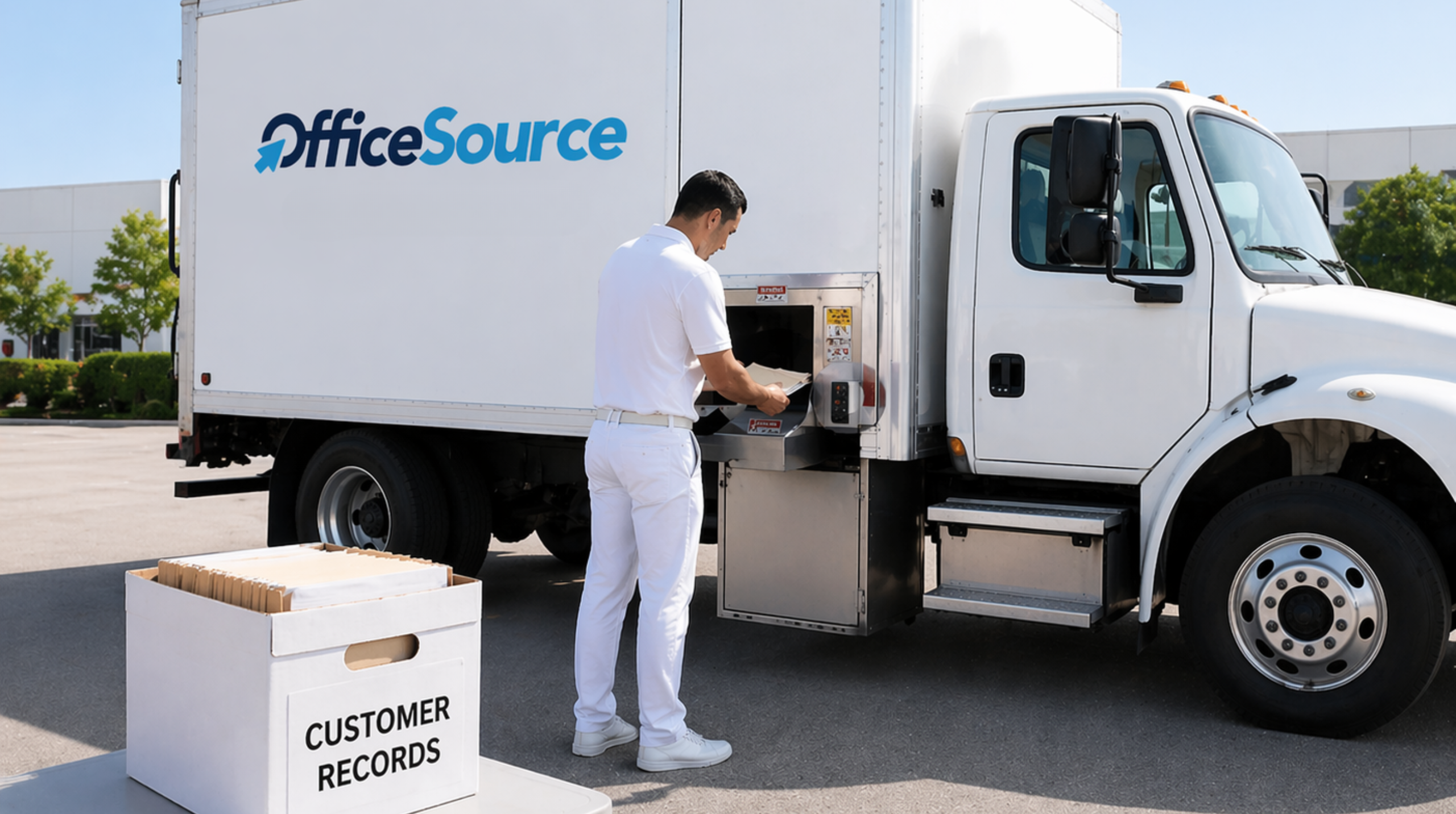
Office Source Shredding Services in St. Louis helps businesses close with confidence. Whether you need a one-time bulk purge of years of accumulated records or ongoing support during your wind-down, our team handles everything securely, professionally, and in full compliance with federal regulations.
We offer on-site mobile shredding that comes directly to your location, so you never have to worry about how your documents are being handled in transit. From paper files to hard drives, we handle it all and provide full documentation, so you have proof of compliance when you need it.
Ready to close without leaving anything behind? OfficeSource will help you finish your document and digital disposal. Contact us today.
Frequently Asked Questions
Should I shred all business documents when closing my business?
No. Some records must be retained for legal, tax, or regulatory purposes. Consult your accountant or attorney before destroying important business records.
How long should business records be kept?
Retention periods vary depending on the type of document and applicable laws. Tax records, employment records, and corporate documents often have different retention requirements. The IRS provides detailed guidance on business record retention.
Is professional shredding more secure than using an office shredder?
For large volumes of confidential business records, professional shredding provides a secure chain of custody, efficient destruction, and documentation such as a Certificate of Destruction.
What happens to the shredded paper?
Most professional shredding providers recycle the shredded paper after secure destruction, helping businesses protect sensitive information while supporting sustainability efforts.
Can Office Source handle a large one-time shredding purge?
Yes. Office Source provides one-time shredding services for businesses that need to securely dispose of large volumes of records during an office closure, relocation, cleanout, or records purge. Our mobile shredding service can come directly to your St. Louis-area location, helping you clear accumulated documents efficiently while maintaining a secure chain of custody.